Book Summary & Preview
A New Leadership Paradigm for the AI Era
The Community Capital Revolution presents a new leadership paradigm for the AI era — one that replaces silos and zero-sum competition with connected ecosystems and compounding collaboration. It is a practical roadmap for leaders, organizations, and communities to build trust, unlock human potential, and create lasting impact together.
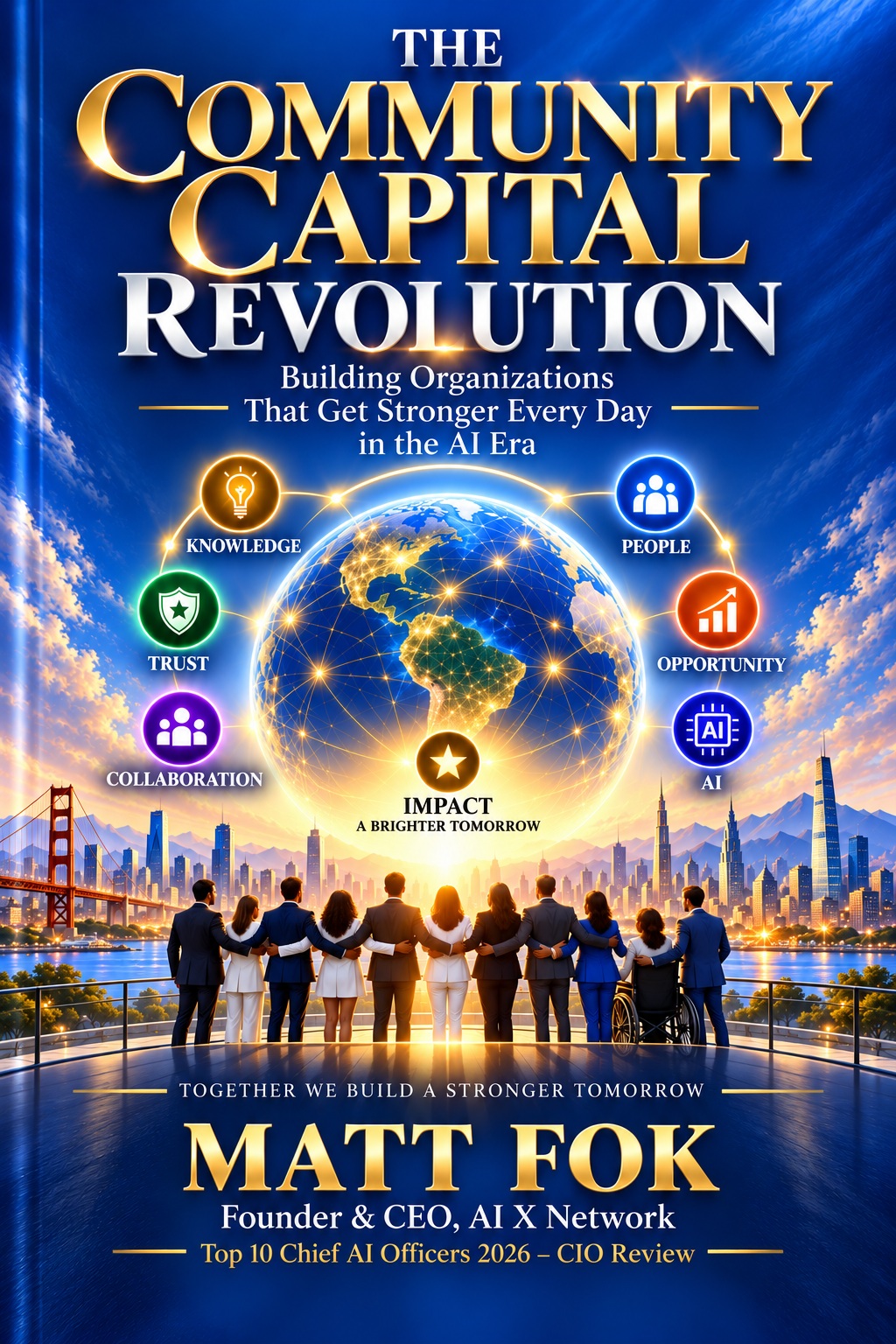
What This Book Is About
A New Mindset
Shift from siloed thinking to connected leadership.
A New Model
Build ecosystems where trust, knowledge, and value flow.
A New Leverage
Use relationships and knowledge networks to multiply impact.
A New Growth Engine
Turn collaboration into compounding growth.
A New Future
Create a human-centered future powered by AI and community.
What You Will Learn
- Why trust is the foundation of every strong community and organization.
- How to break silos and build connected ecosystems that create more value.
- How AI amplifies human potential and strengthens collaboration.
- How to turn vision into action and build momentum that lasts.
- How to measure what matters and drive meaningful, lasting impact.
Key Takeaways
Silos Limit
Isolation creates gaps; connection creates value.
Trust Is Foundational
Trust unlocks collaboration and results.
Knowledge Compounds
Shared knowledge multiplies impact.
AI Amplifies Humanity
Technology should elevate people.
Together, We Thrive
Connected leaders build a better future.
Table of Contents & Chapter Summaries
Explore what awaits you across 15 chapters and 4 parts — from breaking down silos to measuring what truly matters. Open any chapter for its key idea and practical takeaway.
Part I — From Silos to Community Capital
- Key idea: Leadership is moving from hierarchy, control, and competition to trust, collaboration, knowledge sharing, and community.
- Practical takeaway: Connect people, share knowledge, and build trust — create ecosystems where everyone can contribute, grow, and succeed together.
- Key idea: Community Capital is the compounding value created when people, knowledge, trust, AI, and opportunity connect within an ecosystem.
- Practical takeaway: Invest in Community Capital: a connected ecosystem creates compounding value that no siloed organization can match.
- Key idea: Business is evolving from isolated transactions to interconnected ecosystems.
- Practical takeaway: Shift from transactional models to ecosystem models to lead the next era of sustainable growth.
- Key idea: Silos are the silent killers of innovation, collaboration, and growth.
- Practical takeaway: Identify, challenge, and dismantle silos — a leadership mindset shift toward connection, transparency, and shared purpose.
- Key idea: Trust is the invisible infrastructure that makes everything in an organization work.
- Practical takeaway: Build, measure, and restore trust at every level; without it, knowledge isn’t shared and opportunities are missed.
Part II — Activating People, AI & Opportunity
- Key idea: AI is a tool that amplifies human creativity, connection, and collaboration.
- Practical takeaway: Use AI to strengthen human connection, creativity, and collaboration — to serve people, not replace them.
- Key idea: Shared knowledge creates compounding returns.
- Practical takeaway: Build a culture where learning is continuous and collaborative, and knowledge flows freely across teams and ecosystems.
- Key idea: The Opportunity Mindset is the ability to see, create, and share opportunities with others.
- Practical takeaway: Don’t just find opportunities — create and share them, moving from scarcity to abundance.
- Key idea: Vision without action is just a dream.
- Practical takeaway: Start small, build momentum, align people around shared goals, and compound progress every day.
Part III — Building Intelligent, Connected Ecosystems
- Key idea: Leading in the AI era requires new skills, mindsets, and strategies — technology-empowered and human-led.
- Practical takeaway: Use AI to enhance, not replace, human judgment, creativity, and connection.
- Key idea: Intelligent communities are connected, collaborative, and continuously improving — powered by people, knowledge, and AI.
- Practical takeaway: Design communities that learn, grow, and evolve together so trust, knowledge, and opportunity compound over time.
- Key idea: The economy is shifting from a zero-sum model to an Opportunity Economy, where value is created, shared, and compounded.
- Practical takeaway: Create and share value rather than extract it, to drive innovation and a more inclusive, prosperous future.
- Key idea: The future will be defined not by the biggest companies, but by the strongest communities.
- Practical takeaway: Collaborate, share, and grow together — and be part of the movement toward connected communities.
Part IV — Measuring & Strengthening the Revolution
- Key idea: Designed and used with purpose, AI can empower people, strengthen communities, and solve real-world challenges.
- Practical takeaway: Lead with purpose, ethics, and empathy so AI becomes a catalyst for human potential and community growth.
- Key idea: True success is the positive impact we create for people, communities, and the future.
- Practical takeaway: Measure what matters, align actions with purpose, and build a legacy that lasts.
Community Capital in Action
Proven Ecosystem Models
Twelve real-world ecosystem examples that demonstrate Community Capital in action—showing how collaboration, trust, and shared purpose drive measurable impact across business, education, health, faith, local commerce, executive networks, global trade, and storytelling.
Case Study 1
BizBiome
A Business Growth Ecosystem
BizBiome helps small businesses connect with trusted experts, tools, partners, customers, and AI-powered support through a connected ecosystem—not isolated searching.
The Challenge
Small businesses often struggle to find trusted experts, tools, partners, and opportunities. Resources are fragmented, disconnected, and difficult to navigate—making growth slower and more costly.
Case Study 2
Startup365.biz
An Always-On Startup Ecosystem
Startup365.biz helps founders, investors, accelerators, coaches, and service partners connect through a continuous startup ecosystem.
The Challenge
Startup discovery is fragmented. Founders, investors, accelerators, coaches, and service partners often meet only around isolated events instead of building continuous relationships.
Case Study 3
BookExpo365.com
An Author & Reader Ecosystem
BookExpo365.com helps authors, publishers, readers, reviewers, and creative partners stay connected through a continuous ecosystem for discovery, learning, and engagement around books and ideas.
The Challenge
Book launches often fade after the initial campaign. Authors and publishers need ways to sustain discovery, reader engagement, knowledge sharing, and relationships long after launch day.
Case Study 4
StayHealthy365.net
A Continuous Health & Wellness Community
StayHealthy365.net helps people, providers, educators, and wellness experts stay connected through a continuous health and wellness ecosystem.
The Challenge
Health and wellness engagement often stops between appointments, programs, or events. Education, trusted guidance, and community support can become fragmented.
Case Study 5
ReleaseFaith.net
A Connected Faith Community
ReleaseFaith.net helps churches, ministries, members, and mission partners stay connected through a faith ecosystem built around fellowship, discipleship, prayer, and shared purpose.
The Challenge
Churches and ministries want to connect, disciple, serve, and share their mission, but geography, limited resources, and fragmented communication can restrict participation.
Case Study 6
GlobalTrade365.net
A Connected Global Trade Ecosystem
GlobalTrade365.net helps businesses build trusted cross-border relationships by connecting buyers, suppliers, service providers, and market knowledge inside one continuous ecosystem.
The Challenge
Businesses often find it difficult to build trusted cross-border relationships, identify buyers or suppliers, understand markets, and find the right trade and logistics partners.
Case Study 7
LocalBiz365
A Connected Local Business Ecosystem
LocalBiz365 is a connected local business ecosystem that helps local businesses build visibility, attract customers, strengthen referrals, and grow through trusted community relationships.
The Challenge
Local businesses often face low visibility, fragmented demand, and limited access to trusted community support.
Case Study 8
CXO Network
A Trusted Executive Peer Ecosystem
CXO Network helps executives, peer groups, experts, and roundtable communities connect through a trusted ecosystem for leadership exchange, confidential learning, and strategic collaboration.
The Challenge
Executives often lead in isolation while facing complex decisions. They need trusted peers, relevant insights, confidential exchange, and access to expertise they can rely on.
Case Study 9
Daughters of Destiny
A Leadership, Faith & Community Ecosystem
Daughters of Destiny helps women leaders, mentors, faith communities, and learning partners connect through an ecosystem focused on encouragement, purpose, leadership, and impact.
The Challenge
Women seeking growth in purpose, leadership, faith, and impact benefit from trusted communities that provide encouragement, mentors, learning, and relationships.
Case Study 10
aSTEAM Village
An Education & Innovation Ecosystem
aSTEAM Village helps students, mentors, schools, industry partners, and project communities connect through a STEAM ecosystem built around learning, mentoring, and innovation.
The Challenge
Young people need access to STEAM learning, mentors, tools, applied projects, and real-world opportunities that connect education with future pathways.
Case Study 11
EST Global Inc.
An Inclusive Transformation Ecosystem
EST Global Inc. works to build a more inclusive, sustainable, and equitable world by connecting financial inclusion, rural transformation, healthcare, education, and technology inside one impact-driven ecosystem.
The Challenge
Many underserved communities still face fragmented access to banking, rural opportunity, healthcare, education, and economic participation. Transformational solutions are often disconnected instead of working together.
Case Study 12
Teaser & Trailer Showcase
A Creative Storytelling Ecosystem
Teaser & Trailer Showcase connects storytellers, creative partners, audiences, and distribution pathways in one ecosystem for visibility and growth.
The Challenge
Creative projects often struggle with fragmented support, limited visibility, and difficulty reaching the right audience and partners.
The Future Belongs to Connected Leaders
From silos to ecosystem. From competition to collaboration. From isolated to connected.
Become a CCR ChampionQuestions about AI skills, adoption, or community opportunity?