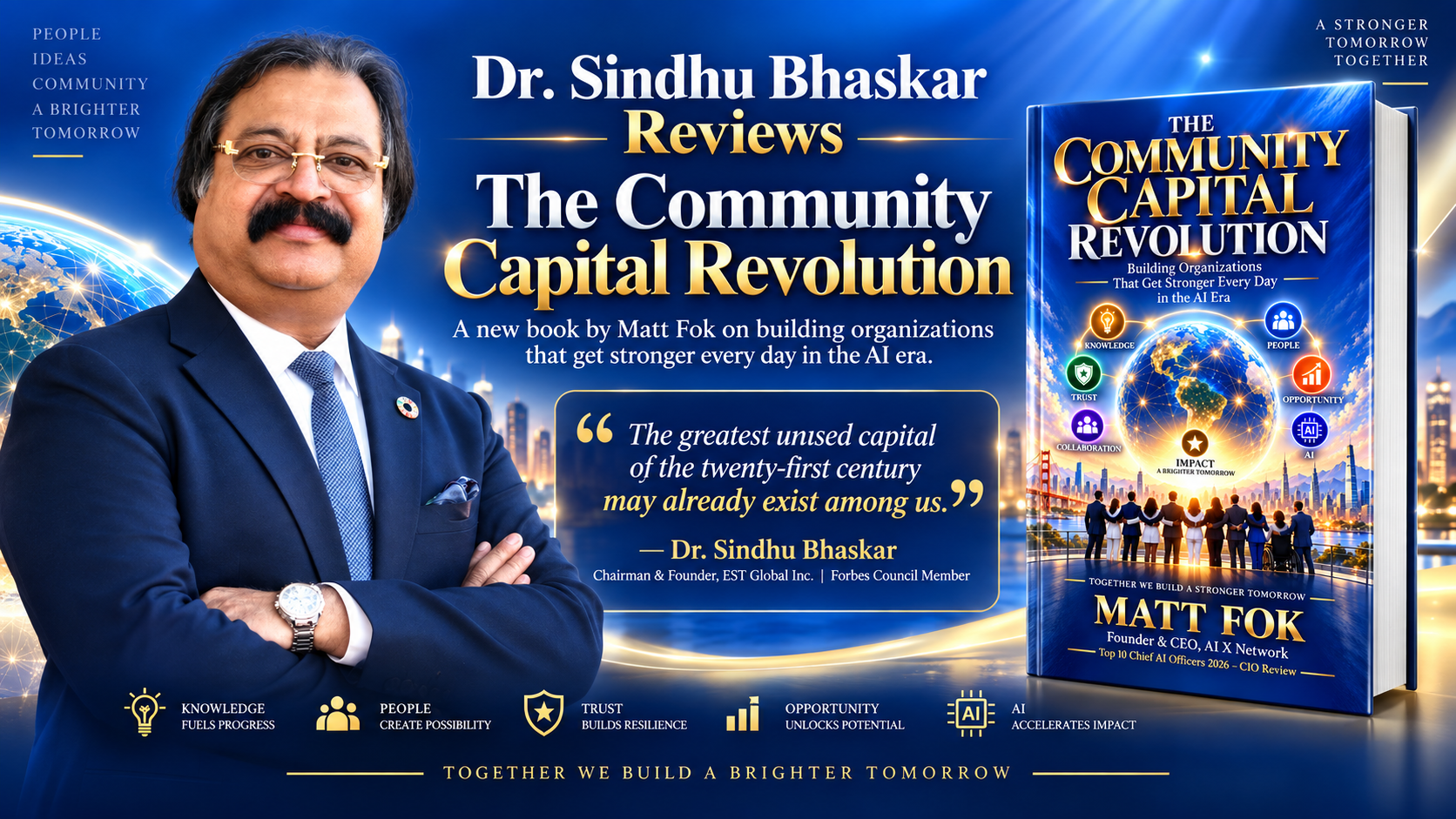
SAN FRANCISCO, CA, UNITED STATES, October 9, 2026 — As artificial intelligence rapidly transforms business, leadership and work, Dr. Sindhu, Chairman & Founder of EST Global Inc. and Forbes Council Member, has issued a detailed review of Matt Fok’s forthcoming book, The Community Capital Revolution: Building Organizations That Get Stronger Every Day in the AI Era.
Dr. Sindhu describes the book as more than another management guide or another explanation of how AI will change business. Its deeper proposition, he writes, is human and social: as technology multiplies intelligence and productivity, enduring organizational strength will increasingly depend on the ability to multiply trust, knowledge, relationships, collaboration and opportunity.
At the center of the book is the concept of Community Capital — the compounding organizational value created when people, knowledge, trust, collaboration, opportunity and AI amplification reinforce one another.
Dr. Sindhu summarizes the opportunity in one powerful observation:
“The greatest unused capital of the twenty-first century may already exist among us.”
From Organizations to Ecosystems
According to Dr. Sindhu, one of the book’s strongest themes is the shift from organization to ecosystem, from control to connection, and from individual advantage to shared capability.
Rather than measuring leadership only by what happens at the top, The Community Capital Revolution asks leaders to consider the health and capacity of the wider ecosystem — employees, customers, partners, experts, investors and communities.
The book also expands the traditional meaning of capital.
Organizations possess more than cash, property, products and contracted labor. They also possess accumulated knowledge, credibility, relationships, teaching capacity, experience, trusted access and human capability — assets that may not appear on a conventional balance sheet but can still determine whether an organization succeeds or fails.
Dr. Sindhu identifies the book’s invitation to discover these “dormant assets” and convert them into active, replenishing capital as one of its most important intellectual contributions.
A Practical Operating Model — Not Just a Theory
Dr. Sindhu also highlights the book’s practical architecture.
Across 15 chapters, the book moves from establishing the foundations of Community Capital to breaking down silos, mobilizing people and opportunity, and building the future collectively. Later sections extend the framework through case studies, action tools, implementation resources and leadership exercises.
Rather than ending chapters with abstract conclusions, the book moves readers toward key takeaways, action plans, executive reflection and specific next steps.
Dr. Sindhu describes the result as less like a conventional business book and more like a:
“visual operating manual for institutional change.”
AI Should Amplify Community — Not Replace It
The review gives particular attention to the book’s human-centered treatment of artificial intelligence.
In Fok’s framework, AI is not the destination.
AI helps discover, match, route, personalize and scale, while people retain responsibility for judgment, decisions and accountability. Dr. Sindhu emphasizes that AI should amplify Community Capital rather than substitute for human community.
That distinction leads to one of the book’s most timely ideas:
AI can make intelligence more abundant. Community Capital can help turn that intelligence into opportunity and impact.
The book argues that lasting advantage will not come simply from deploying more AI.
It will come from combining AI with stronger relationships, better knowledge circulation, trusted collaboration and ecosystems in which more people can contribute and create value.
Beyond Business
Dr. Sindhu’s review also explores the broader social potential of Community Capital.
He considers how the framework could be applied to a town, university, rural district, professional association or urban neighborhood.
Instead of asking only, “How much money do we have?”, communities could also ask:
- What knowledge do we possess?
- Who has useful skills?
- Who enjoys trust?
- What relationships already exist?
- What needs remain unmet?
- Who can connect a need with a capability?
- What technology could amplify that connection?
The review illustrates how retired professionals could mentor others, universities could make expertise available to local enterprises, small businesses could share market intelligence, corporations could contribute knowledge as well as money, and AI could help match skills with needs.
Dr. Sindhu further notes that the model could be tested around practical challenges such as employment, entrepreneurship, education, healthcare access and local business development.
A Different Measure of Strength
The review also praises the book for looking beyond activity and transactions.
The deeper question is whether capability, trust, connection, contribution and opportunity are actually becoming stronger over time.
Dr. Sindhu captures the philosophy in another striking observation:
“A strong organization does not merely accumulate capital; it creates conditions in which people create capital in one another.”
He closes with an equally important measure of success: the Community Capital Revolution should ultimately be judged not by how much technology an organization deploys, nor simply by how rapidly it grows, but by whether its people, relationships, institutions and communities are stronger than they were before.
More Than a Book
The Community Capital Revolution is designed not simply as a business book, but as the foundation for a broader movement focused on helping individuals, businesses, nonprofits, associations, educational institutions and communities turn relationships, knowledge and trust into shared opportunity.
Its practical message can be summarized simply:
Knowledge becomes opportunity.
Connections become collaboration.
Ideas become action.
Action becomes impact.
As AI continues to accelerate change, the book makes the case that human connection may become more important — not less.
The Community Capital Revolution officially launches Oct 19, 2026.
Full Book Review
Review of The Community Capital Revolution by Matt Fok
Building Organizations That Get Stronger Every Day in the AI Era
Matt Fok's The Community Capital Revolution is not merely a book about organizational management, nor is it another manual explaining how artificial intelligence will transform business. Its more significant proposition is human and social: in an age when technology can multiply intelligence and productivity, an organization's enduring strength will depend on its ability to multiply trust, knowledge, relationships, collaboration, and opportunity.
This idea is captured in the book's central concept of Community Capital—the compounding organizational value produced when people, knowledge, trust, collaboration, opportunity and AI amplification reinforce one another. The author carefully avoids presenting Community Capital as a replacement for financial capital. Rather, it represents the often-unrecognized human, relational, and ecosystem assets that determine how effectively other forms of capital can actually be used.
Theme and central argument
The book's strongest theme is the shift from organization to ecosystem, from control to connection, and from individual advantage to shared capability. Fok argues that the conventional command-and-control organization was designed for a more predictable environment. The contemporary world—characterized by rapid technological change, uncertainty, changing workforce expectations and demands for purpose—requires a different leadership architecture.
Accordingly, leadership moves from managing an organization to leading an ecosystem. Success is no longer interpreted simply as the authority or performance of those at the top, but through the health and capacity of the wider network of employees, customers, partners, experts, investors and communities.
This gives the word capital a broader meaning. Financial statements recognize cash, property, products, and contracted labor because they can be readily measured. Yet organizations also possess accumulated knowledge, credibility, relationships, teaching capacity, experience, trusted access and human capability. These may not appear on a conventional balance sheet, but they can determine whether an organization succeeds or fails. The book therefore invites leaders to discover the "dormant assets" within society and organizations and convert them into active, replenishing capital.
That is perhaps the book's most important intellectual contribution.
Structure and presentation
The book's architecture supports its philosophy. Its fifteen chapters are organized into four broad movements: establishing the foundations of Community Capital; moving from silos toward ecosystems; mobilizing people and opportunity; and building the future collectively. The later practical sections extend the argument through case studies, action tools, implementation resources, and leadership exercises.
The structure is intentionally progressive. The reader first understands why leadership must change, then what Community Capital consists of, followed by how to activate it, and finally how to measure and sustain its results.
An especially effective feature is that chapters do not end with abstract conclusions. They move toward key takeaways, action plans, and executive reflection. Chapter 1, for example, translates leadership theory into four horizons—today, this week, this month, and 90 days—asking the reader to identify a real change, conduct listening exercises, apply ecosystem leadership, and establish a learning cycle.
This makes the volume less like a conventional business book and more like a visual operating manual for institutional change.
The visual presentation reinforces this character. Diagrams, pathways, circular models, maps, scorecards and ecosystem illustrations reduce conceptual complexity. The Community Capital diagrams are particularly useful because they repeatedly remind the reader that people, knowledge, trust, relationships and opportunity are not independent variables; their value increases through interaction.
At times the visual density is considerable, and readers accustomed to continuous academic prose may find the presentation unconventional. But this appears deliberate. The book is designed to be used, not simply read. Its own instruction is essentially "see, understand, and apply," with reflection converting insight into practical action.
The language is deliberately simple, motivational and executive rather than academic. Short statements, questions and memorable formulations dominate. This makes the book accessible to different audiences, corporate executives, entrepreneurs, community leaders, educators, and younger professionals.
Importantly, simplicity does not mean that the underlying idea is simplistic. Behind phrases such as "stronger together" lies a systemic proposition: an organization can create a positive feedback loop in which relationships produce trust, trust facilitates knowledge exchange, knowledge reveals opportunities, collaboration converts opportunity into outcomes, and the learning from those outcomes returns to strengthen the network.
Artificial intelligence fits naturally into this architecture. The book does not portray AI as the destination. AI discovers, matches, routes, personalizes, and scales, while people retain responsibility for decisions and accountability. This distinction is crucial. The argument settles that AI should amplify Community Capital rather than substitute for human community. Earlier chapters similarly emphasize freeing people to focus on creativity and relationships while AI supports information and decision-making.
This human-centered treatment of AI substantially increases the book's contemporary relevance.
From organizations to society
The larger question is whether Community Capital can move beyond corporate management and become useful to society. I believe this is where the book opens its most interesting possibilities.
Imagine applying the Community Capital Asset Map to a town, university, rural district, professional association, or urban neighborhood. Instead of beginning with the question, "How much money do we have?", the community would also ask: What knowledge do we possess? Who has skills? Who enjoys trust? What relationships already exist? What needs remain unmet? Who can connect a need with a capability? What technology could amplify this connection?
The book itself frames activation around four practical questions: what assets exist, who stewards them, who may access them, and what outcome activates them.
Applied socially, this could have substantial consequences. A retired engineer could mentor others. A university could make expertise available to local enterprises. Small businesses could share market intelligence. Community organizations could identify underserved groups. AI could match skills with needs. Corporations could contribute knowledge as well as money. Young people could obtain access to mentors and networks previously unavailable to them.
In such a system, social development becomes less dependent upon isolated institutions continually creating new resources. Society begins by connecting and activating resources it already possesses.
The book also offers an important ethical safeguard: participation should be voluntary, permissioned, governed, and connected to meaningful outcomes. This matters because community cannot become an excuse for extracting people's knowledge, relationships, or labor. Community Capital succeeds only when trust itself is protected as capital.
Implementation therefore requires local Community Capital maps, trusted conveners, clearly defined needs, transparent access rules, accountable ownership, measurable outcomes, and mechanisms through which learning and value return to contributors.
Governments, universities, companies and civic institutions could test the model initially around one defined problem—employment, entrepreneurship, education, healthcare access or local business development—rather than attempting wholesale institutional transformation.
The likely effect would not simply be greater efficiency. If implemented faithfully, the deeper outcome would be greater connectedness and institutional resilience: fewer isolated pools of expertise, stronger knowledge circulation, more visible opportunity and potentially greater participation by people who traditionally remain outside established networks.
The book wisely extends measurement beyond activity. Its later argument is that measurement itself shapes culture: what institutions repeatedly measure attracts attention, reinforces behavior, and eventually influences what the community becomes. Thus, the purpose is not merely to count transactions but to determine whether capability, trust, connection, contribution, and opportunity are actually becoming stronger.
The message of the book
Ultimately, The Community Capital Revolution carries a deceptively simple message:
The greatest unused capital of the twenty-first century may already exist among us. It resides in people, their knowledge, their trust, their relationships, and their capacity to create opportunities for one another. Technology, and especially AI, can reveal and amplify that capital, but people must give it purpose.
The revolution in the title therefore is not primarily technological. It is a revolution in how we understand value.
The old question was: What does the organization own?
The emerging question is: What can the ecosystem become when what everyone knows, contributes, and trusts is intelligently connected?
That transition—from possession to participation, hierarchy to ecosystem, isolated capability to collaborative intelligence, and technology-centered efficiency to human-centered amplification—is the book's enduring message. It also explains why its central idea can travel beyond the corporation into education, entrepreneurship, communities, and society itself.
In that sense, Matt Fok's proposition is both practical and philosophical: a strong organization does not merely accumulate capital; it creates conditions in which people create capital in one another. When knowledge is shared, trust strengthens, opportunity becomes visible, and learning returns to the community, growth becomes cumulative rather than extractive.
The most meaningful measure of the Community Capital Revolution, therefore, will not be how much technology an organization deploys, nor even how rapidly it grows. It will be whether, after every interaction, its people, relationships, institutions and communities are stronger than they were before. That is the book's challenge and its hope.
Dr. Sindhu Bhaskar
Chairman & Founder, EST Global Inc. · Forbes Council Member
Read the Book Dr. Sindhu Reviewed
Launching October 19, 2026. The first 1,000 qualifying buyers receive a complimentary 12-month CCR Membership — a $99 value.
About Dr. Sindhu
Dr. Sindhu is Chairman & Founder of EST Global Inc. and a Forbes Council Member. In his review of The Community Capital Revolution, Dr. Sindhu examines the book’s implications for organizational leadership, artificial intelligence, ecosystems, communities and society.

About Matt Fok
Matt Fok is the author of The Community Capital Revolution and Founder of AI X Network. His work focuses on AI-enabled communities, collaborative intelligence, ecosystem development, and helping organizations create continuous value through relationships, knowledge, trust and shared opportunity.
No One Rises Alone. Together, We Rise.